Markus Passecker
I work at the intersection of augmented reality, cultural memory, and live performance, building systems that return digitized histories to the places where they happened. My practice spans academic research, XR commissions, biofeedback performances, and spaces between them.
Two-month residency at Zvjezdane Staze as one of three Artists in Residence selected for the first edition of TEREN_SЛОЈЕVИ. Project description and notes from the field will appear here across the residency window.
Concept
A mine extracts silver, lead, and zinc from the ground thirty kilometers from Mijakovići. The water continues downstream through the same watershed that feeds tens of thousands of households. What it carries after is not what it carried before.
Watershed begins from this fact, but it does not document it. The project extends an existing trilogy of biofeedback works (Water for One, Water for None, Water for Two) into a fourth iteration developed specifically for this residency and its conditions. Across the trilogy, the same apparatus (a shallow container of darkened water, stone, vibration transducers, body sensors) has been coupled to three different bodies: the live performer's, the recorded body in the performer's absence, and two simultaneous visitors. Each shift asks the same question differently: whose body is the apparatus coupled to, and what does that change about what the water does?
The fourth iteration couples the apparatus to the watershed itself and the environment. Not as metaphor, as method. Field recordings from the mine's acoustic perimeter, the river, the village, the surrounding ground are used as signal sources alongside real environmental data from the watershed: air quality, water temperature, particulate levels. These are the numbers the mine produces as a matter of routine monitoring. Here they are routed, without interpretation, into the same transducer chain that has always carried heartbeats. The stone in the water is sourced from the region. What appears on the surface is not a representation of extraction; it is the extraction displaced, as physiological signals always have been in this work, into the only medium available: a shared surface of darkened water.
The resulting piece has two states that are not separate works but a single apparatus in two modes. In its installation state, the piece runs without the performer. Recorded field material is routed through the transducer chain; the stone moves; the water responds. In its performance state, the performer sits beside the container. The body sensors return. Heartbeat, muscle activity, breath mix with field recordings on the same shaker chain. Two signal sources, the body and the landscape, meet on the same surface without being compared, hierarchized, or narrated. The body is not a measuring instrument for the landscape; the landscape is not a backdrop for the body. They share the water.
The question Water for None asked was about the persistence of a physiological gesture after the body leaves the room. Watershed asks what is left in a landscape after extraction.
Relation to Sound / Extraction / Memory
The three registers of this edition are not three separate themes to be addressed in sequence. They name a single condition.
Work in progress
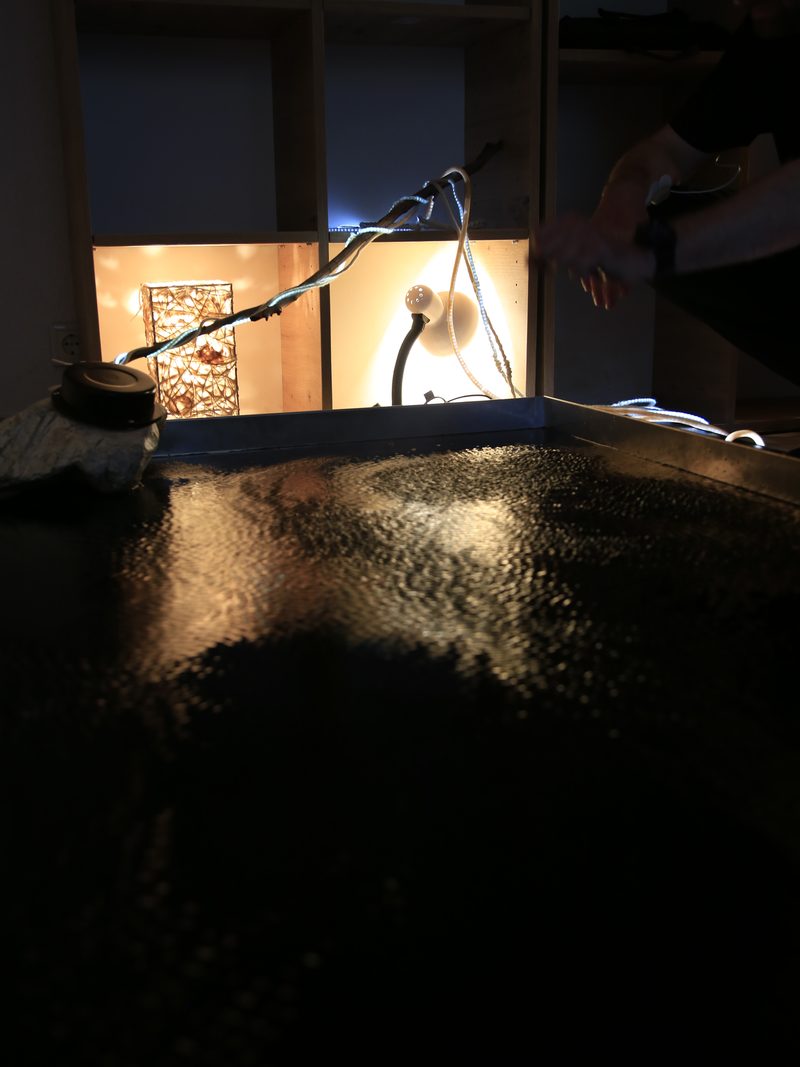
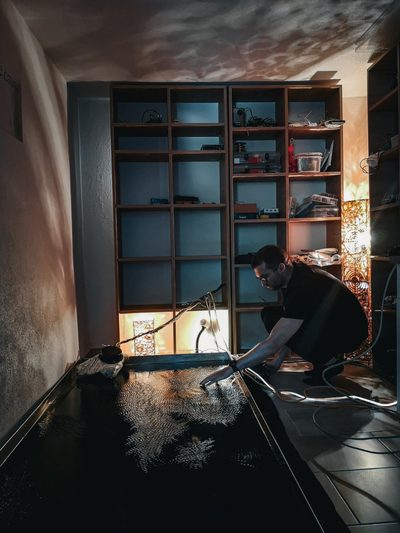
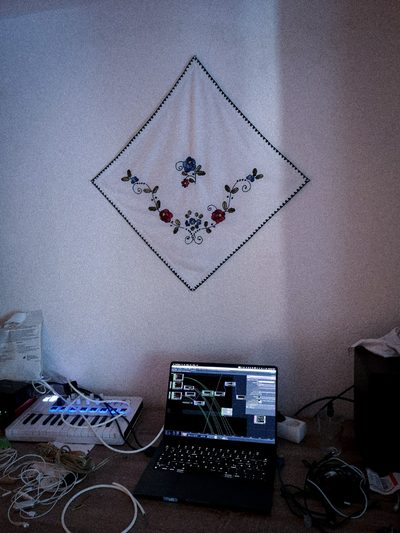
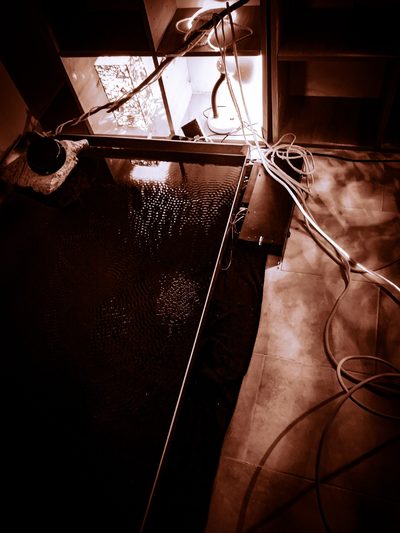
Photographs · Yutong Zhang and Belma Bešlić-Gál
Peer-reviewed publications
- Passecker, Markus, Silvia Miksch, Franziska Proksa, and Wolfgang Aigner. 2025. "The Past Is All around You: Augmenting Cultural Heritage on-Site." In EuroVis 2025 · Posters, edited by Alexandra Diehl, Kostiantyn Kucher, and Nicolas Médoc. The Eurographics Association. doi.org/10.2312/evp.20251143
- Passecker, Markus, Victor A. de Jesus Oliveira, Paolo Buono, Silvia Miksch, and Wolfgang Aigner. 2025. "Reconnecting Artifacts and Place: A Review of Situated Visualization in Cultural Heritage." 2025 9th Workshop on Visualization for the Digital Humanities (VIS4DH), Vienna, Austria. doi.org/10.1109/VIS4DH69385.2025.00006
Performances & installations
Artistic practice
EVN.Δ (16.83_97) · 2025 · K1_ARt, Austria & Sarajevo
Hafen · 2024/2025 · K1_ARt, Vienna
Winterantwort · 2024/2025 · K1_ARt, Vienna
Practice areas
Situated Visualization & AR/MR
Unity · AR Foundation · ARCore · Blender · point cloud processing
Live Performance & Creative Coding
TouchDesigner · Mixed-Media · Processing · Biofeedback Systems
External
.png)
TEREN_SЛОЈЕVИ⁰⁰¹·Δ26 is funded by the European Union under the Culture Moves Europe programme, implemented by the Goethe-Institut. Views and opinions expressed are those of the author(s) only and do not necessarily reflect those of the European Union or the Goethe-Institut. Neither the European Union nor the granting authority can be held responsible for them.